Last episode we met Nancy Salzman who is still in the fog of her denial (for now) and Keith’s trial began with witnesses Sylvie and Mark Vicente on the stand.
We open with a warning that Tourette’s Syndrome is a neurological disorder and “the experiments shown in this episode were not conducted by licensed clinical professionals.” That’s for damn sure.
We cut to video titled “ESP: The nature of emotions.” Nancy Salzman tells us Keith Raniere has “quantified the structure of emotions.” Oh, did he now? According to Nancy this has never been done in the history of human psychology. You’re right, Nancy. You wanna know why? Because it is not possible, okay? “Quantifying the structure of human emotions” doesn’t make any sense anyway. It’s just words put together.
Nancy talks about something in ESP called “State Control.” Why did all their modules have such cheesy names? Anyway, it’s an emotional reaction based on a meaning we have given to various events in our lives. We may not realize we have chosen our emotional responses to this or that, but we have, based on the meaning we have given the situation.
She gives an example as getting angry at a situation or something someone has done. The impulse is there, but we don’t have to act on it if we understand our anger is really about how we are perceiving the situation. The meaning we have applied to it. Pretty much. That’s the gist.
Sounds reasonably logical, right? In some situations that would be true, sure. But, if all of our responses to things are merely conditioned, that also means human beings have no innate sense of right or wrong, compassion, empathy etc. Keith was big on this idea, because he liked to teach to his followers morality was a construct and it’s all subjective.
An example of this is the time Keith told his followers about a girl he knew who had been sexually abused by her father. According to Keith “she loved it” until society taught her it was wrong. I know reading that is horrifying. But it’s important to remember how so much of the ESP shit started off sounding reasonable and empowering, but it was really about opening many doors for Keith to eventually warp people’s thinking. Anyway, intro.
We cut back to Nancy. The camera pans to a bookshelf and there is a stack of books by Ayn Rand. Make of that what you will. She takes us to her garage and shows a lot of poster boards with crap written by Keith on them. These were made during the period they were creating the modules for ESP. Nancy tells us Keith did not want to throw away anything he ever wrote. Nancy reads a couple of nonsensical lines from one of the posters. Throwing up her hands, she says, “I don’t know what he was trying to say, but… we laminated it.” Keith was such a dork. Not in the endearing way either.

Nancy explains the idea was for Keith to be able to take his “very special skill for behavior change” and qualify it as scientific: reproducible, verifiable, consistent and measurable. He had an idea and then he had a bunch of concepts he taught to Nancy. We hear Keith ask Nancy to explain what “responsibility” means. Responsibility: the causes, their effects and your participation. Yeah, we know. We can look the word up in the dictionary if we’re not clear, thanks.
Nancy ended up creating 2000 modules from all of Keith’s blathering. She really wanted to see how effective ESP would be for people with all types of problems like chronic pain and eating disorders. Keith said they should start working with healthy people first who just wanted to change patterns of behavior that limit them. But, Nancy tells us, people would come that had certain disorders and ask if the program would help them. And then Marc Elliot showed up.
Marc Elliot
Marc is seated at a table, talking to the filmmakers. He gives us a mini bio. He developed tics as a child that got considerably worse by high school. He describes it as like having a very uncomfortable itch that needs to be scratched. The tic is like the scratch to that itch.
Marc tried many serious drugs to treat the symptoms, but the side effects were so severe they affected his quality of life worse than the tics did. He decided to forget medication and just focus on living his life. He became an activist of sorts with a goal of educating the public about Tourette’s with a message of acceptance and tolerance.
We see him in front of various audiences. In one clip, it looks like he is ticcing so badly he won’t be able to speak, but then he interjects, “I have Tourette’s, by the way.” His delivery is good, he’s funny and the audience laughs. Doing this work made him feel good about what he was doing externally, but internally he did not have peace.
Marc tells us he did not check out ESP for treatment with his Tourette’s. But, during an EM demo with Nancy on “fear sourcing” (cheesy!) meaning getting to the root of a fear–Marc had an insight about his Tourette’s. He wondered if maybe he was afraid of losing the Tourette’s. In its own way, it made him feel special. This thought changed his perception and he no longer saw himself “as a victim to this thing.”
He calls this a paradigm shift in terms of how to think about the disease. The more he focused on getting to the root, the less itch he had and, as a result, his tics decreased greatly. He recalls being in a crowded train station one day and seeing, for the first time in his life, he was just like everyone else. It was an amazing realization.
We cut to Marc speaking in front of a large audience. He tells them he met an amazing man: an American scientist and philosopher named Keith Raniere. This is the man who created the tools that enabled him to beat his Tourette’s. Everyone cheers and claps.
You know, it’s funny and kind of amazing how Nancy is barely mentioned or given much props for her contribution to all this. She’s the one conducting the sessions–from what I can see in video clips throughout this doc– with other people who were seeking help with their Tourette’s. Yet, the majority of the credit goes to fucking Keith. Maybe it’s a dubious distinction, given thoughts we will hear from prosecutor Moira Penza later on in the episode, but still.
Marc tells us it has been four years since he has struggled with tics. And let me just add he comes across as genuinely relaxed and symptom free. If he still gets urges–and I’m not saying he does–he certainly gives no indication he struggles in any way with that. That is why he is so grateful, he tells us. Getting choked up, he admits before ESP he had lived a “horrible 20 years.” His loyalty and faith in Keith is not because of indoctrination. How would someone feel, he asks us, towards the people who enabled him to live a life he never thought possible?
Clifton Park, New York
Because of Marc’s success, NXIVM decided to do a “study” on the effects of ESP tools on people with Tourette’s. Nancy tells us in present day she did not do much research on Tourette’s before she began, because she didn’t want to prejudice herself. She talked briefly with Keith about it all, but he just told her to use every tool she knew and to not hold back. Amazing direction, Keith. I can really see why you were considered the genius behind this miraculous program.
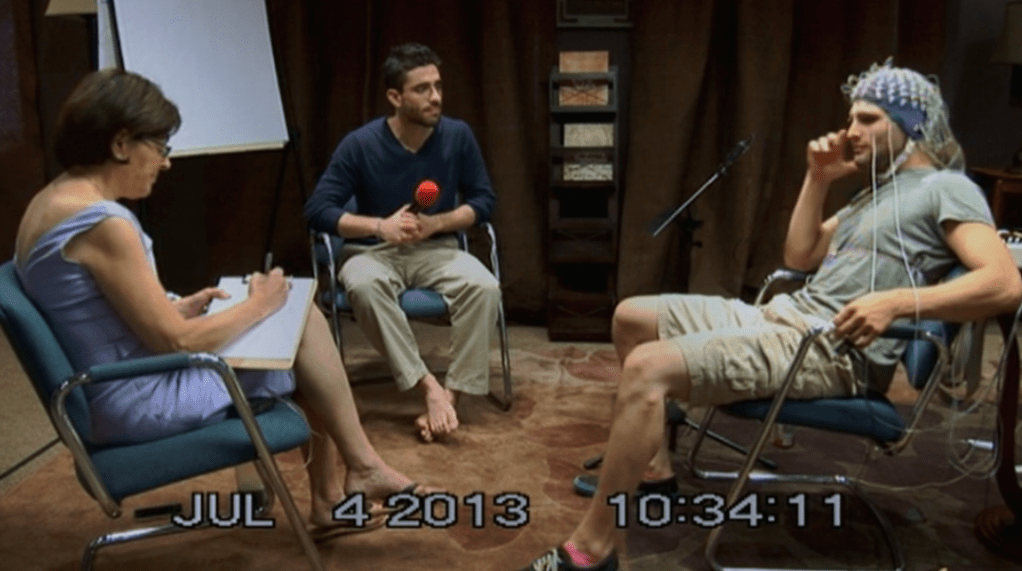
We see a video clip of a session. Nancy asks the young man she is working with what his concerns are. He says he’s afraid it might not work. We cut to Nancy who tells us she worked mainly with a person’s beliefs. She used the EM (Exploration of Meaning) method to get to the root of people’s self perceptions. Sarah Edmonson talked about this in season one. Removing self-limiting beliefs was a big part of ESP’s appeal.
But there is also another aspect of EMs Nancy did which she describes as disconnecting stimulus and response. For example, how we react to a tone of voice that reminds us of our mom when she was angry. You hear that tone from anyone and you experience an automatic response. If you can disconnect the trigger and the response, she explains, you wouldnt experience that reaction anymore. She applied that process to the clients with Tourette’s. It seems to have helped with one young woman we see who is amazed by the decrease in intensity of her urge to tic.
We cut to video of Marc with Keith. They are discussing Keith’s lack of scientific credentials. Sometimes unconventional thinking works, Keith says, if other approaches to problems have not. I fucking love how Keith is sitting there taking 100% credit for Marc’s success in all of this. What a tool.
The results were dramatic. “Palpable.” Marc says with certainty this program will cure Tourette’s. Marc is then asked about a woman named Isabella. Looking uncomfortable, he says if Isabella wants to speak on her experience with ESP that is up to her.

We then cut to Isabella. She explains the work Nxivm was doing with Tourette’s was really seen as something that would help legitimize the company. It was an example of an extreme transformation that was visible in a physical way. It would make it obvious then, the company had developed profound tools.
Isabella has dealt with severe Tourette’s and OCD since she was young. She tells us she assumed she’d wake up one day and the tics would just be gone. But during her last year of college, her tics started to intensify again after a period of more manageable symptoms. At that point, her family would have done anything, she says. I am not sure how her family heard about ESP, but she and her mom met with Nancy. Nancy gave Isabella her first EM. From there she moved to Albany to participate in the NXIVM study.
On day three, Isabella tells us, she experienced a perception shift. She thought back to 3rd grade when she experienced her first tic, clearing her throat. What if instead of responding the way she did she just acknowledged the urge but did nothing? “Bodies can be uncomfortable,” she says. It made Tourette’s a choice and it had never occurred to her to see it that way. “It changed everything.”
In a video clip from during the study, Isabella shows no signs of ticking at all. In a second clip, Isabella says she would put her Tourette urges at a one or a two of intensity. There is the occasional urge, but it is very infrequent.
Isabella tells us in present day she is super grateful to Nancy. She changed Isabella’s life, but that has nothing to do with why she left.
December 2017
Isabella and former NXIVM member Kevin Hermann, drive up to her town house in Albany. They very quickly pack her stuff and load it into the car. Like fast. This must be right at the time The Frank Report had posted about DOS and the branding.
As they drive away, she tells whoever is filming there are far more dangerous things going on than she imagined. She admits she knew shady things were going on before, but she justified it.
Brooklyn, New York
Isabella is at a friend’s place in Brooklyn. She Facetimes with Marc Elliot who says, “I heard you ran out in the middle of the night.” Isabella tells him she heard some information that wasn’t good and she needs time to evaluate away from the community. Marc is bewildered, “Who do you think I am? What do you think I do?” Isabella tells Marc she loves him very much and he has nothing to do with it.
The conversation continues:
Marc: “Some women decided to get a brand as a way to fucking bond.”
Isabella: “No no no. Women were told they were going to get a tattoo. It was not an informed–”
Marc: “What if that’s not true?”
Isabella: “What if it is?”
Marc, sounding angry, replies condescendingly: “If that was true Isabella, that’s called illegal. That’s called assault.“
Isabella, still calm, says that is why she left.
Marc tells Isabella she is choosing to believe people who aren’t being honest with her. Isabella says he needs to consider maybe the people he is choosing to believe aren’t being honest with him. Marc reminds Isabella he and Nancy have helped her a lot and she is choosing to trust other people over him. The conversation concludes with Marc telling her he is going to continue working with NXIVM. When it comes to treating Tourette’s, they have the best results in the world.
We hear the door bell ring and it’s a former NXIVM member, Vasco Bilbao-Bastida. Isabella, Vasco and Kevin (the friend who helped her pack) sit down and over wine and Oreos (yuck, guys) talk about the situation with Marc.
Vasco says he has known Marc for a long time, back from 2004 when Marc first came in to ESP. His tics at this time were quite severe. Vasco says Marc has said he will never leave NXIVM, no matter the charges against Keith. ESP has the power to cure Tourette’s, period.
We cut back to Marc. Keith’s a pioneer with an incredible mind and capacity to help people, he tells us. I don’t disagree Keith has an above average insight to human psychology and an ability to look at situations from different perspectives. He’s a con man. It’s a requisite for the job.
Anyway, people have asked Marc, “Why don’t you branch out on your own?” But he feels he can’t because anything he does will be tainted by the sex cult label and his refusal to disavow Keith. “I will always be a hated figure,” he says. That’s a little melodramatic, but yes, he invalidates himself with his blind devotion to Keith. You know, Marc is a proactive guy. He could have been talking to people in the medical profession, for example, sharing his personal process that lead to the control over his tics. Instead, he focused on shouting from the rooftops Keith is this miracle worker. I don’t get it. At least acknowledge it was Nancy who worked with him, not Keith.
By the way, not everyone who went through the Tourette’s program experienced success. One woman who was interviewed by the prosecution said all she got from it was damaged self-esteem and feeling like a failure. Later in the episode, we will understand how that happened for some people. For most people? I don’t know what the success rate was with the study.
Marc tells us the only way he can share the means to cure Tourette’s to people who will listen is by “exposing this injustice.”
Clifton. New York
Nancy FaceTimes with Diane Benscoter, an expert in psychological manipulation. She asks Nancy what her current thoughts are about Keith.
Nancy felt Keith was kind in the beginning, but got “more and more and more” controlling as time went on. But, she never thought about leaving, she says. She just thought he was “difficult.”
In voice over as we watch her do some house chores, Nancy tells us after Keith ran off to Mexico, she started waking up in the morning feeling peaceful. She had no insight as to why that was and she felt guilty. She felt she should feel grateful for NXIVM and (presumably) Keith.
We then cut to a video clip from 2009. Keith, Nancy and an unidentified person are sitting at a table in a kitchen, it looks like. Keith begins to go on one of his typical spiels on God knows what bullshit. Nancy, trying to be unobtrusive, speaks softly into a tape recorder giving the date etc. So, not only was everything filmed, but recorded on tape, too? Anything else, Keith? Maybe a stenographer? A mason, perhaps, who can carve into a slab of marble a memorial to celebrate this important moment?
Keith stops talking, annoyed at what he sees as an interruption. Calmly, but with utter contempt, he tells Nancy, in so many words, she is an idiot and to never speak when he is speaking.
We cut back to Nancy present day, who tells us she was “terrified” of Keith. He was constantly disrespectful to her in front of other people and he made her feel dumb and embarrassed. As a result, she felt completely disempowered. But she was stuck in a loop of wanting his approval.
I think this is important to recap to understand the psychological vulnerabilities Nancy had that Keith took advantage of. She traces her need for approval to her mom who, inadvertently, encouraged her to be a people pleaser. Nancy had dyslexia, which made school hard for her and her mom called her “little dummy.” Not defending her mom, but back in the day dyslexia wasn’t well understood and it was sometimes seen as a lack of intelligence. Nancy was stupid, her mother basically said, but she was lovable and loving. That was what she was good at.
Nancy thinks Keith recognized her desire for approval and withheld it on purpose. As a result, Nancy worked harder to please him. Mark Vincente told us in season one Keith laid that trip on everyone. He’d figure out your sore spot and fuck with your head about it, intensifying feelings of insecurity and failure. As the authority figure over the entire community, everyone wanted his approval.
Nancy tells us she feels “this is how he got me to do everything he got me to do.” This is interesting. Like what? Is it that on the peripheral of her denial, she’s aware she enabled a lot of fucked up shit? Because at this point in the doc, she remains bewildered. She knew about DOS for example, but she felt it had nothing to do with her.
Buffalo, New York
Isabella is at her parent’s house. In voice over, she tells us working with Nancy opened her up to looking at choice in a way that felt empowering, but it became absolute. Every struggle a person had was seen as a choice and was therefore their fault, a reflection of their poor character.
While in ESP, Isabella was pressured to go off the 40 different medications she had been taking since she was a child to help with her Tourette’s and OCD. The withdrawal was brutal. Her tics were more controlled, but her OCD got worse. When she reached out for support from Marc Elliot, she was told the intense discomfort was creating growth. When she talked to Nancy about her struggles with symptoms, she told Isabella she was “attention seeking.” Isabella, feeling ashamed of what she perceived as her moral failings, withdrew into herself.
We are shown a clip of Nancy who explains when we give in to physical urges and feelings, it is a “[breach] of our ideological ethics.” Christ. Ideological ethics, my ass. Keith always had to go for the most convoluted terms in an attempt to sound profound.
Isabella is still struggling emotionally with the aftermath of her experience. Trying to explain the methodology of ESP and how it broke her (and so many others) down hasn’t been easy to explain to her parents. Her mom feels Isabella needs time to heal, but her dad doesn’t want her to give in to depression. He thinks she needs to think about what her next steps forward will be and get going.
We cut to Keith’s attorney Marc Agnifilo, who tells us the results of the Tourette’s study proves ESP did good things. People stayed in not because of coercion, he says, but because the program helped people.
Prosecutor Moira Penza is like, bullshit. Cognitive Behavioral Therapy has been an effective tool in treating people with Tourette’s. Nancy probably incorporated some techniques that helped a small number of people who participated in the study, she says, but regardless, Keith had nothing to do with it.
Moira explains one of the reasons NXIVM was dangerous was because they used legitimate psychological tools, but in “a manipulative and corrosive way.” Many of the people who participated in the Tourette’s study were harmed further, because really, the most important thing was showing results to make Keith look good. Participants were pressured to show improvement with no concern for their mental and emotional health. Moira describes the study as predatory and unethical.
We cut to Isabella who is heading to Brooklyn, because she wants to attend Keith’s trial. She thinks it will bring closure.
Then we cut to Nancy’s house. She is with her daughter Michelle, whom we have never met. They are cracking up about the early years when Nancy and Keith were still developing modules for ESP. Michelle tells the filmmakers Nancy would sometimes use nutty terms like “parasitic” to describe she and Lauren’s misbehavior. “We were like, what the fuck?” Michelle says, laughing.
Michelle understands Nancy was trying to keep her daughters accountable using these new strategies. She understands Nancy was motivated by a desire to be a good mother, because she loved them. Michelle says that’s why she and Lauren “followed you anywhere.” She says this without resentment. “Right,” Nancy says, looking very sad.

Nancy is still confused at this point in the doc, though. She doesn’t understand how Keith could create “something so beautiful” and yet do something so terrible. One thing. She clearly has a long way to go. Her lawyer told her she and Lauren had to plead guilty because if not, they would definitely be going down with Keith. Nancy thinks she and Lauren were both arrested so the prosecution could pit them against each other. Oh, girl.
We then cut to a video clip of Keith giving a lecture. “The body can do so much more than the mind alone,” he says nonsensically. He says there is an ESP drill to demonstrate this and calls Lauren up to assist. But then he has to tell Lauren what he wants her to do, because this “drill” is something he probably just made up. He has her press her hands against his and mirror his movements. Naturally, she’s not able to, because she’s not a fucking mind reader. He tells her she’s “thinking too much.” Right.
He turns his head away so he’s not looking at her and tells Lauren he will mirror her movements instead. He’s not able to, because he’s not a fucking mind reader, either. He starts to dominate the movements, moving faster and getting more aggressive. Lauren stumbles backward and he ends up accidentally socking her in the face. Bravo, Keith! This demo was great! I totally understand the point you were making now.
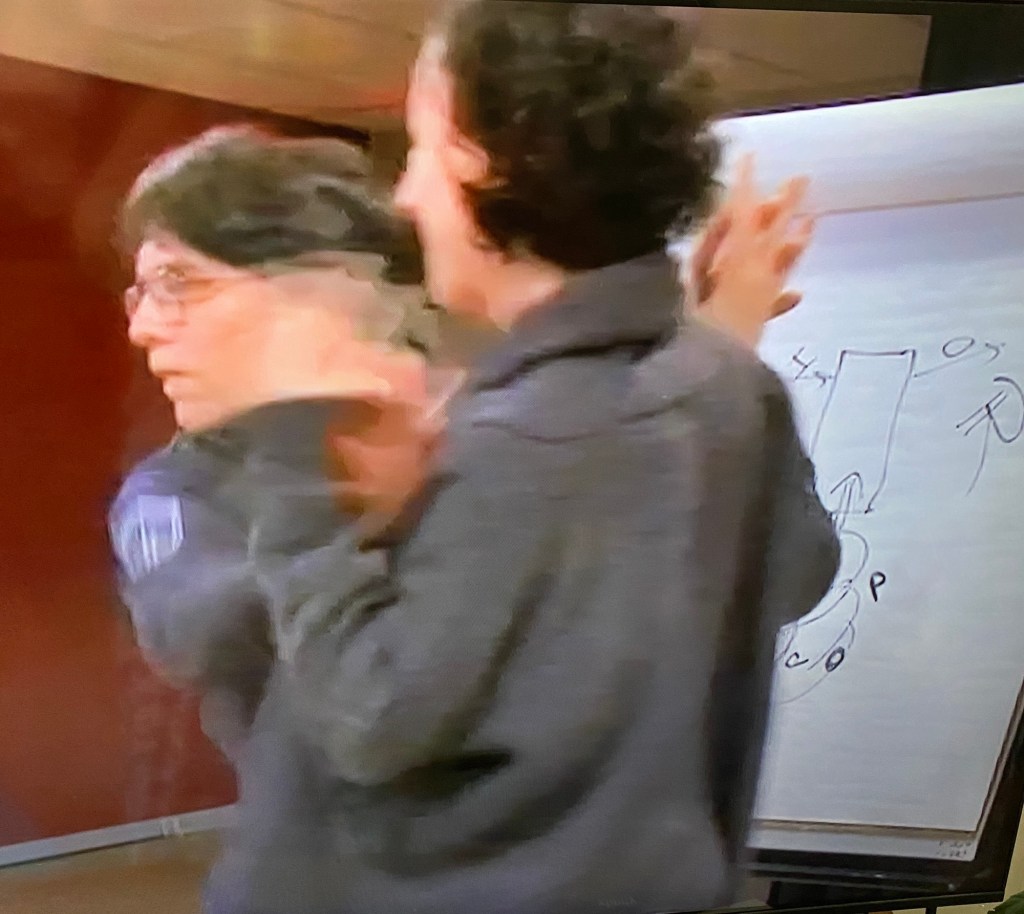
“If you learn to suspend your mind, the body can do all sorts of things,” he sagely tells his audience. Then he blathers about how they need to ask themselves “what do you really want and how you much are you willing to devote to being a master at it.” How that ties into the demonstration and “suspending your mind” is a pointless question, because it’s just Keith running his mouth, as usual. Lauren is sitting in the audience still holding her face. He must have hit her pretty hard. “Are you okay?” he asks her. As if he cares.
We cut back to Nancy who tells us though it was very hard for her, because she still loved Keith, Lauren cooperated with the prosecutors. She ended up providing more information than they had any idea about.
At the close out of the episode we hear a reporter say Lauren will be the first co-conspirator to testify against Keith. As we look at a courtroom sketch we hear the beginning of her testimony. She tells the court she was with NXIVM for about 20 years. Keith was the one who had approached her about joining DOS. What was she willing to do to strengthen their relationship and continue on the path of personal growth, he had asked her.
“What did you say?” asks the prosecutor.
“Anything… Anything.”
Next episode “The Breach.”
 Recapulet
Leave a comment